Friday, May 17, 2013

Unit 7

  • Balance of payments

    • Measure of money inflows and outflows between the United States and the Rest of the World (ROW)
      • Inflows are referred to as CREDITS
      • Outflows are referred to as DEBITS
    • The Balance of Payments is divided into three accounts
      • Current Account
      • Capital/Financial Account
      • Official Reserves
  • Double Entry Bookkeeping

    • Every transaction in the balance of payments is recorded twice in accordance with standard accounting practice
      • Ex: U.S. manufacturer, John Deere, exports $50 million worth of farm equipment to Ireland
        • A credit of $50 million to the current account (-$50 million worth of farm equipment or physical assets
        • A debit of $50 million to the capital/financial account (+$50 million worth of Euros or financial assets)
    • Notice that the two transactions offset each other. Theoretically, the balance payments should always equal zero… Theoretically
  • Current Account

    • Balance of Trade or Net Exports
      • Exports of goods/services (inflow)
      • Import of goods/services (outflow)
      • Exports create a credit to the balance of payments
      • Imports create a debit to the balance of payments

    • Net Foreign Income
      • Income earned by U.S. owned foreign assets – Income paid to foreign held U.S. assets
      • Ex. Interest payments on U.S. owned Brazilian bonds – Interest payments on German owned U.S. Treasury bonds
    • Net Transfers (tend to be unilateral)
      • Foreign Aid → a debit to the current account
      • Ex. Mexican migrant workers send money to family in Mexico
  • Capital/Financial Account

    • The balance of capital ownership
      • Includes the purchase of both real and financial assets
    • Direct investment in the United States is a credit to the capital account
      • Ex. The Toyota Factory in San Antonio
    • Direct investment by US. firms/individuals in a foreign country are debits to the capital account
      • Ex. The Intel Factory in San Jose, Costa Rica
    • Purchase of foreign financial assets represents a debit to the capital account
      • Ex. Warren Buffet buys stock in Petrochina
    • <!--[endif]-->Purchase of domestic financial assets by foreigners represents a credit to the capital account
      • The United Arab Emirates sovereign wealth fund purchases a large stake in the NASDAQ
  • What causes capital/financial flows?

    • Differences in rates of return on investment
    • Ceteris Paribus, savings will flow toward higher returnRelationship Between Current and Capital Account
    • Remember Double entry bookkeeping?
    • The current account and the capital account should zero each other out
    • That is… if the current account has a negative balance (deficit), then the capital account should then have a positive balance (surplus)
  • Official Reserves

    • The foreign currency holdings of the United States Federal Reserve System
    • When there is a balance of payments surplus, the Fed accumulates foreign currency and debits the balance of payments
    • When there is a balance of payments deficit, the Fed depletes its reserves of foreign currency and credits the balance of payments
    • The official reserves zero out the balance of payments
  • Credits vs. Debits

    • Credits - additions to a nation's account
    • Debits - subtractions to a nation's account
  • How to Calculate the Following

    • Typically...
    • Balance on trade:
      • Merchandise & service exports minus merchandise & service imports
      • If have both, then goods exports minus goods imports
    • Trade deficit occurs when the balance on trade is negative (imports > exports)
    • Trade surplus occurs when the balance on trade is positive (exports > imports)
    • Balance on Current Account
      • Balance on trade (exports & imports) + Net investment income + Transfer payments
    • Official Reserves
      • Nationally: Change in CA + Change in FA + Change in Official Reserves = 0
  • Foreign Exchange (Forex)

    • The buying and selling of currency
      • Ex. In order to purchase souvenirs in France, it is first necessary for Americans to sell (supply) their dollars and buy (demand) Euros
    • The exchange rate (e) is determined in the foreign currency markets
      • Ex. The current exchange rate is approximately 77 Japanese Yen to 1 U.S. Dollar
    • Simply put, the exchange rate is the price of a currency
      • Do not try to calculate the exact exchange rate
    • Ex. We demand (tourist places) Cancun from Mexico
  • Changes in Exchange Rates

    • Exchange rates (e) are a function of the supply and demand for currency
      • An increase in the supply of a currency will decrease the exchange rate of a currency
      • A decrease in supply of a currency will increase the exchange rate of a currency
      • An increase in demand for a currency will increase the exchange rate of a currency
      • A decrease in demand for a currency will decrease the exchange rate of a currency
  • Appreciation and Depreciation

    • Appreciation of a currency occurs when the exchange rate of that currency increases
    • Depreciation of a currency occurs when the exchange rate of that currency decreases
      • Ex. If German tourists flock to America to go shopping, then the supply of Euros will increase and the demand for dollars will increase. This will cause the Euro to depreciate and the dollar to appreciate
  • Exchange Rate Determinants

    • Consumer Tastes
      • Ex. A preference for Japanese goods creates an increase in the supply of dollars in the currency exchange market which leads to depreciation of the dollar and an appreciation of Yen
    • Relative Income
      • Ex. If Mexico's economy is strong and the U.S. economy is in recession, then Mexicans will buy more American goods, increasing the demand for the dollar, causing the dollar to appreciate and the Peso to depreciate
    • Relative Price Level
      • Ex. If the price level is higher in Canada than in the U.S., then American goods are relatively cheaper than Canadian goods, thus Canadians will import more American goods causing the U.S. dollar to appreciate
    • Speculation
  • Demand $ - exports and capital inflows

    • When the U.S. exports goods/services to other countries, they need OUR dollar to complete the transaction. So they demand OUR money, first they need to SUPPLY theirs.
  • Supply $ - imports and capital outflows

    • When we import goods/services from other countries, we need THEIR money to complete the transaction. So we demand THEIR money, we need to SUPPLY ours.
  • Tips

    • Always change the D line on one currency graph, the S line on the other currency's graph
    • Move the lines of the two currency graphs in the same direction (right or left) and you will have the correct answer
    • If D on one graph increases, S on the other will also increase
    • If D moves to the left, S will move to the left on the other graph
  • Flexible/Floating Exchange Rate

    • Set by market forces with little or no government intervention
  • Fixed Exchange Rate - determined by government policies
  • Absolute Advantage v. Comparative Advantage

    • Absolute Advantage
      • Faster, more, more efficient
    • Comparative Advantage
      • Lower opportunity cost
  • The same country can have an absolute advantage in two products

  • Sunday, April 28, 2013

    Unit V and VI


    From Short Run to Long Run

    ·         AS curve doesn't shift in response to changes in the AD curve in the short run

    ·         i.e.--Nominal wages do not respond to price-level changes

    o    Workers may not realize impact of the changes or may be under contract

    ·         Long Run--Period in which nominal wages are fully responsive to changes in price level

    -When changes occur in the short run, they result in either increased or decreased producer profits--not changes in wages paid
    -Nominal--What I'm pa id
    -Real--What the real value is

    ·         In the long run, increases in AD result in a higher price level, as in the short run, but as workers demand more money, the AS curve shifts left to equate production at the original output level, but now at a higher price

    ·         In the ling run, the AS curve is vertical at the Natural Rate of Unemployment (NRU), or full employment level (FE) level of output. Everyone who wants a job has one and no one is enticed into or out of the market

    -Demand Pull Inflation will result when an increase in demand shifts the AD curve to the right, temporarily increasing output while raising prices.

    -Cost-Push inflation results when an increase in input costs that shifts the AS curve to the left. In this case, the price level increases is not in response to the increase in AD, but instead the cause of price level increasing.

    The Phillip's Curve

    ·         Inverse relationship with unemployment and inflation

    ·         It represents the relationship between unemployment and inflation so that the tradeoff between inflation and unemployment occurs over the Short Run. Each point on the Phillip's Curve corresponds to a different level of output.

    ·         LRPC

    o    Occurs at the natural rate of unemployment (NRU)

    o    It is represented by a vertical line

    o    No tradeoff between unemployment and inflation in the long run

    1.      The Economy produces at the full employment output level

    2.      The nominal wages of workers fully incorporate any changes in price level as wages adjust to inflation over the long run

    3.      LRPC only shift if the LRAS curve shift (same determinants)

    LRPC Curve

    ·         Increases in Unemployment will shift LRPC --->

    ·         Decreases in Unemployment will shift LRPC <---

    Increases in AD = Up/Left movement along the SRPC
    Decrease in AD = Down/Right along SRPC

     
    Natural Rate of Unemployment is equal to

    ·         Frictional

    ·         Structural

    ·         Seasonal

    The Natural Rates & Fuel worker benefits create a lower NRU

    ·         Extremely high unemployment if employers were required to provide health care

    Supply Shock--A rapid and significant increase in resource costs which causes the SRAS curve to shift

    Misery Index Practice Problem
    Assume that major political events stop the delivery for oil tot he country, shifting the SRAS curve on the aggregate model. On the Phillips Graph, show how the SRAS shift would affect the SRPC. Use 4% as the original LRPC:

    ·         Unemployment Rate:

    o    Last Year 3%, This Year 5%

    ·         Inflation Rate:

    o    Last Year: 8%, This Year 3%


    Misery Index
    ·         A combination of inflation & unemployment in any given year--single digit misery is good
    ·         If the inflation rate persists and the expected rate of inflation rises, then the entire SRPC moves upward, so when that happens, stagflation exists
    ·         If inflation expectations drop, then the SRPC moves downwards
    Stagflation--Occurs when you have high unemployment and high inflation occurring at the same time

    Disinflation--When inflation decreases over time
    ·         Nominal wages increases
    ·         Business profits fall as prices are rising, firms reduce employment thus unemployment decreases.
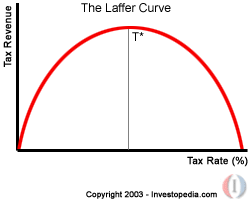
    Laffer Curve
    As tax rates increase from 0, tax revenues increase from 0 to some max level and then decline. The higher tax rate you set, the less money you will collect. Laffer Curve is controversial and debatable.
     
    Criticisms:
    1.      Where the economy is located on the curve is difficult to determine
    2.      Tax cuts also increase demand which can fuel inflation
    3.      Empirical evidence suggest that the impact of tax rates on incentives to work, save, and invest are small (Basically no incentive)
    Supply-Side economics or Reaganomics
    They support policies that promote GDP growth by arguing that high marginal tax rates along with the current system of transfer payments (unemployment, social security, etc.) provide disincentives to work, interest, innovate and undertake entrepreneurial ventures
    ·         Belief that the AS curve will determine levels of inflation, unemployment, and economic growth.
    ·         Reaganomics--> Triple-Down Effect
    o    Rich-->Poor
    Marginal Tax Rate
    Amount paid or the last dollar earned or on each additional dollar earned. Supply side economist believe of there is a reduction in the marginal tax rates, more people would be inclined to work longer, thus foregoing leisure time for extra income.

    The Phillips Curve

    LRPC:
    Because the LRPC exists at the natural rate of unemployment, structural changes in the economy that affect unemployment will also cause the LRPC to shift.
    Relating Phillips Curve to AS/AD:
    · Changes in the AS/AD model can also be seen in the Phillips Curves
    · An easy way to understand how changes in the AS/AD model affect the Phillips Curve is to think of the two sets of graphs as mirror images.
    *The 2 models are not equivalent. The AS/AD model is static, but the Phillips Curve includes change over time. Whereas AS/AD shows one time changes in the price-level as inflation or deflation, The Phillips curve illustrates continuous change in the price-level as either increased inflation or disinflation

    Summary of the Phillips Curve:
    • There is a short-run trade off between u% & π%. This is referred to as a short-run Phillips Curve (SRPC)
    • In the long-run, no trade-off exists between u% & π%.This is referred to as the long-run Phillips Curve (LRPC)
    • The LRPC exists at the natural rate of unemployment (un).
    –     un ↑ .: LRPC à
    –     un ↓ .: LRPC ß
    • ΔC, ΔIG, ΔG, and/or ΔXN = Δ AD = Δ along SRPC
    –     AD à .: GDPR↑ & PL↑ .: u%↓ & π%↑ .: up/left along SRPC
    –     AD ß .: GDPR↓ & PL↓ .: u%↑ & π%↓ .: down/right along SRPC
    • Δ Inflationary Expectations, Δ Input Prices, Δ Productivity, Δ Business Taxes and/or ΔRegulation = Δ SRAS = Δ SRPC
    –     SRAS à .: GDPR↑ & PL↓ .: u%↓ & π%↓ .: SRPC <--
    –     SRAS ß .: GDPR↓ & PL ↑ .: u%↑ & π%↑.: SRPC -->


    Economic Growth and Productivity
    Conditions for Growth:

    • Rule of Law

    • Sound Legal and Economic Institutions

    • Economic Freedom

    • Respect for Private Property

    • Political& Economic Stability

    –     Low Inflationary Expectations

    • Willingness to sacrifice current consumption in order to grow

             Trade

    • Saving

             Physical Capital:

       •Tools, machinery, factories, infrastructure

       •Physical Capital is the product of Investment.

       •Investment is sensitive to interest rates and expected rates of return.

       •It takes capital to make capital.

    • Capital must be maintained.

             Technology and Productivity:

       •Research and development, innovation and invention yield increases in available technology.

       •More technology in the hands of workers increases productivity.

       •Productivity is output per worker.

    • More Productivity = Economic Growth.


    Human Capital:

    • People are a country’s most important resource. Therefore human capital must be developed.

    • Education

    • Economic Freedom

    • The right to acquire private property

    • Incentives

    • Clean Water

    • Stable Food Supply

    • Access to technology


    Hindrance to Growth:
               •Economic and Political Instability
               –High inflationary expectations
               •Absence of the rule of law
               •Diminished Private Property Rights
               •Negative Incentives
               –The welfare state
               •Lack of Savings
               •Excess current consumption
               •Failure to maintain existing capital
               •Crowding Out of Investment
               –Government deficits & debt increasing long term interest rates!
               •Increased income inequality à Populist policies
    •         Restrictions on Free International Trade